



Puma 4th Generation at Hort Connections 2026
The leading event for the Australian fresh produce industry returns
From 1st to 4th June, Adelaide will host a new edition of Hort Connections, the trade show that over the last ten years has become one of the leading events for the Australian and New Zealand fresh produce industry.
The event brings together growers, packagers, retailers and technology and packaging suppliers from across the Asia-Pacific region, with an increasingly strong focus on sustainability, automation and production efficiency throughout the entire supply chain.
Representing us will be our trusted partner Propak Industries, which from 2nd to 4th June will officially introduce Puma 4th Generation to the Australian and New Zealand markets: our thermosealing netting machine designed to ensure production continuity and minimise machine downtime.
Puma 4th Generation: unprecedented production continuity
During the packaging process, even a brief interruption can result in lost time, slowdowns and increased line management complexity. Puma 4th Generation was specifically developed to keep production smooth and continuous while simplifying daily operations.
Activities that would normally require stopping the machine can now be carried out without interrupting the production cycle: tube change can be performed without stopping the machine, while cooling water and handle replenishment can be managed externally. In addition, the absence of doors, replaced by safety barriers, allows even faster and more immediate access.
The result is a more stable line, with fewer micro-stops and consistently reliable performance over time.
P-Pack: efficiency and sustainability
Today, true efficiency no longer means only speed, production stability during processing or excellent packaging performance, but also resource optimisation and waste reduction.
The Australian fresh produce market is currently among those most strongly oriented towards packaging solutions capable of ensuring both production reliability and packaging quality and sustainability.
Puma offers an approach that allows packagers to reduce material usage without compromising either the final product presentation or operational continuity: P-Pack, the thermosealed net produced by Puma and entirely of PE, is made with 50% less plastic compared to similar packaging solutions currently available on the market.
Propak Industries looks forward to meeting you
Propak Industries looks forward to welcoming you with Puma 4th Generation from 2nd to 4th June at the Adelaide Convention Centre, Stand 100.
📌 Adelaide Convention Centre, Adelaide
📅 2–4 June
👉🏻 Stand 100
Packaging and Packaging Waste Regulation in the operational phase
The time for technical implementing acts
One year after the PPWR entered into force and introduced harmonised rules across the EU on packaging design, recycling, reuse and recycled content, the focus has now shifted to the technical implementing acts, which will define the details that will have a concrete impact on companies starting as early as next year.
What does this mean? The European Commission is preparing precise design criteria (the so-called design for recycling), recyclability requirements, clearer and more standardised labelling, and greater traceability of packaging throughout the entire supply chain, including its end-of-life management.
Practical implications
To begin with, the materials used will change. Above all, packaging will have to meet new requirements in terms of weight reduction, favouring ultra-light solutions. This means that the regulation will directly impact the very structure of packaging: complex laminated films and solutions incompatible with existing recycling systems will gradually disappear. Plastic will remain dominant, but it will be:
- thinner
- more recyclable
- more standardised
Preparing for mono-material packaging
The deadline by which all packaging placed on the market must be recyclable remains 2030, but the transition has already begun. As the PPWR enters its operational phase, pressure on packagers to adapt their packaging is becoming increasingly real. The shift towards mono-material solutions is now underway.
France is certainly leading this trend, anticipating the solutions required by the PPWR by applying a system that will soon be extended across Europe, where the cost of packaging depends on:
- recyclability
- recycled content
- compatibility with the circular economy
Implications for packaging machinery
Not only will new solutions need to be developed to reduce material usage, but machines will also need to handle mono-materials and lighter, more delicate or less stable materials more effectively.
Furthermore, the PPWR encourages the standardisation of packaging itself (as well as labelling) to facilitate recycling and reuse. Less variety in packaging, therefore, but higher volumes per format. This is where productivity, operational continuity and machine reliability become even more critical.
Puma 4th generation
It is within this context that the fourth generation of the Puma Thermosealing netting machine was developed. Puma 4th generation has been designed to further improve the operational continuity of the previous version, reducing downtime and optimising workflow:
- the tube can be replaced without stopping the machine
- cooling water and handle can be refilled externally
- the machine has no doors and is equipped with safety barriers, ensuring faster and easier access
Puma 4th generation ensures not only speed, but a steady, uninterrupted production rhythm.
P-Pack
The result? The same as always: P-Pack, the lightest thermosealed PE net on the market, made with 50% less plastic compared to the similar solutions currently available.
Looking ahead
Puma 4th generation and P-Pack represent a concrete response to a change already in motion. The PPWR marks a paradigm shift that will progressively redefine packaging standards for the fresh produce sector across Europe. While it introduces new requirements in terms of packaging design and recyclability, it also accelerates an evolution already underway, where material efficiency and compatibility with the circular economy are becoming central factors.
In this scenario, the role of packaging machinery becomes even more strategic: no longer simply a tool for packaging, but a solution designed to ensure operational continuity, precision, and full compatibility with new material requirements. Preparing today means not only complying with future regulations, but also seizing the opportunity to make processes more efficient, sustainable and competitive in the long term.
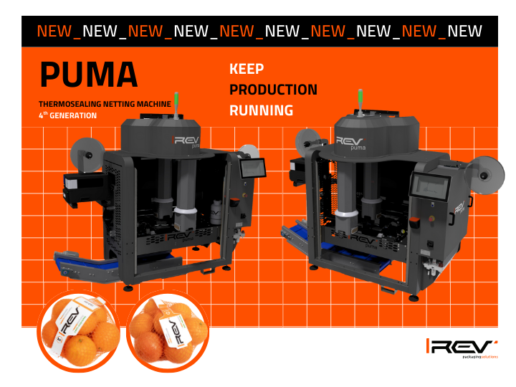
Puma 4th generation: production never stops
Always in motion
In fresh produce packaging, every machine stop means lost time and organisational challenges. The fourth generation of Puma has been designed to minimise interruptions, ensuring smooth and continuous production throughout the shift.
Fewer stops, more efficiency
Daily operations that previously required a machine stop can now be performed without interrupting the production cycle: tube change takes place without stopping the machine, cooling water and handle can be refilled from the outside, and the machine has no doors, it is equipped with safety barriers instead, ensuring even faster access. The result is a more stable line, with fewer micro-stoppages, and predictable, reliable output.
Simplicity for operators
Puma 4th Generation is designed to simplify operators’ work: fewer manual interventions mean greater control over the process.
Consistent performance over time, and production takes off
With Puma, the priority is not peak speed, but maintaining consistent performance. This translates into real efficiency, uniform quality, and peace of mind for operators, ensuring production never stops, in fact, it takes off!
Come and discover the new version of Puma at FRUIT LOGISTICA, Hall 2.1, Stand B-23. We look forward to seeing you there!
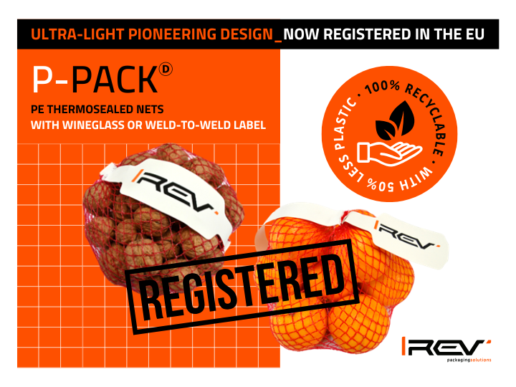
P-Pack becomes a registered EU model
Sustainability and functionality recognised
P-Pack is now protected as a registered design at European level, an important recognition that highlights its distinctive shape, including the handle and the two types of label, as well as its record-breaking grammage. And now that it is official, we can tell you more about why P-PackⒹ truly is a revolution (without forgetting tradition).
What is P-PackⒹ
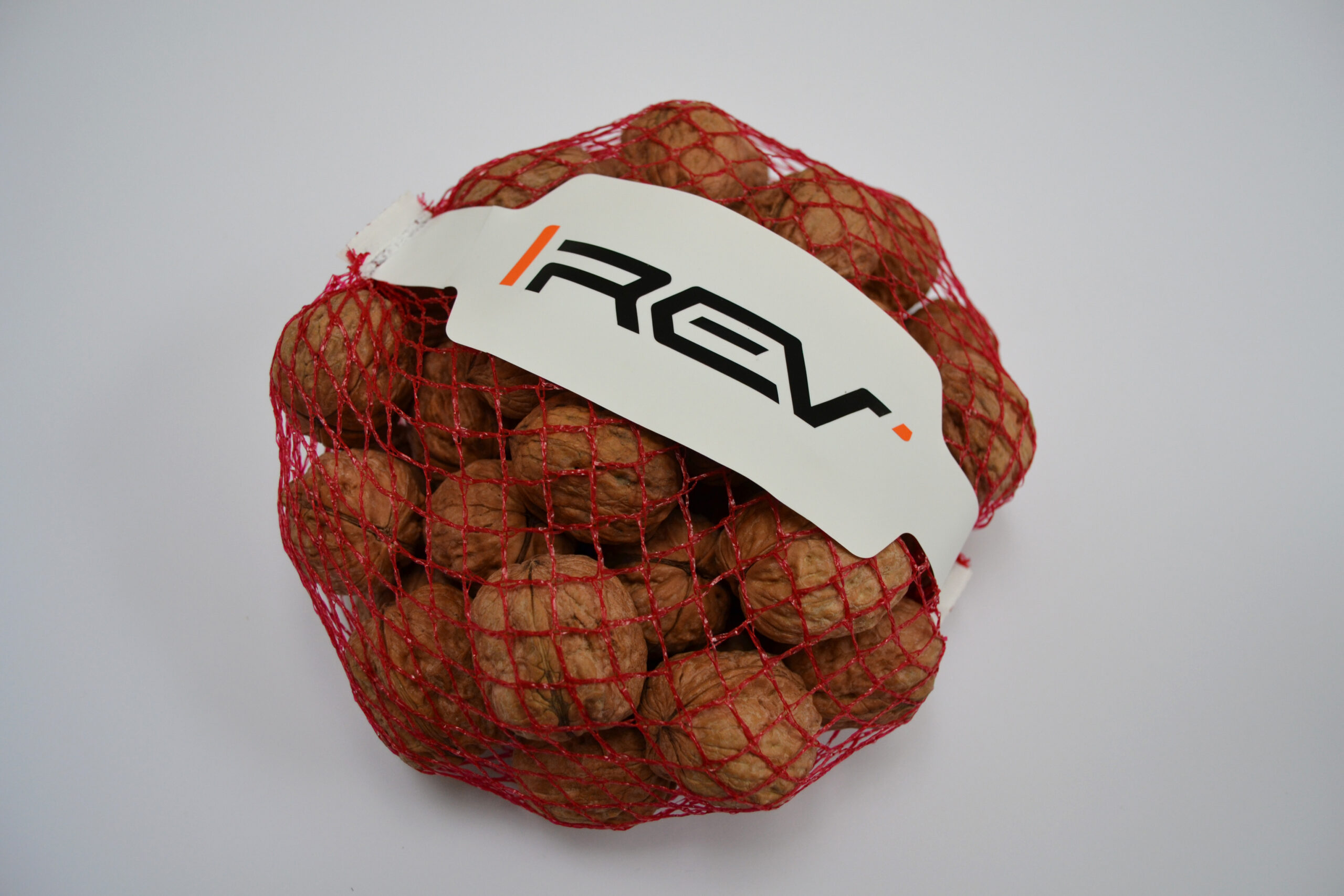
P-PackⒹ is a thermosealed net made entirely of polyethylene (PE), therefore 100% recyclable, consisting of:
- thermosealed tubular net;
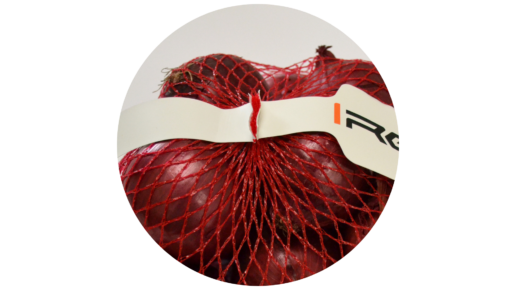
- a ribbon functioning as a handle;
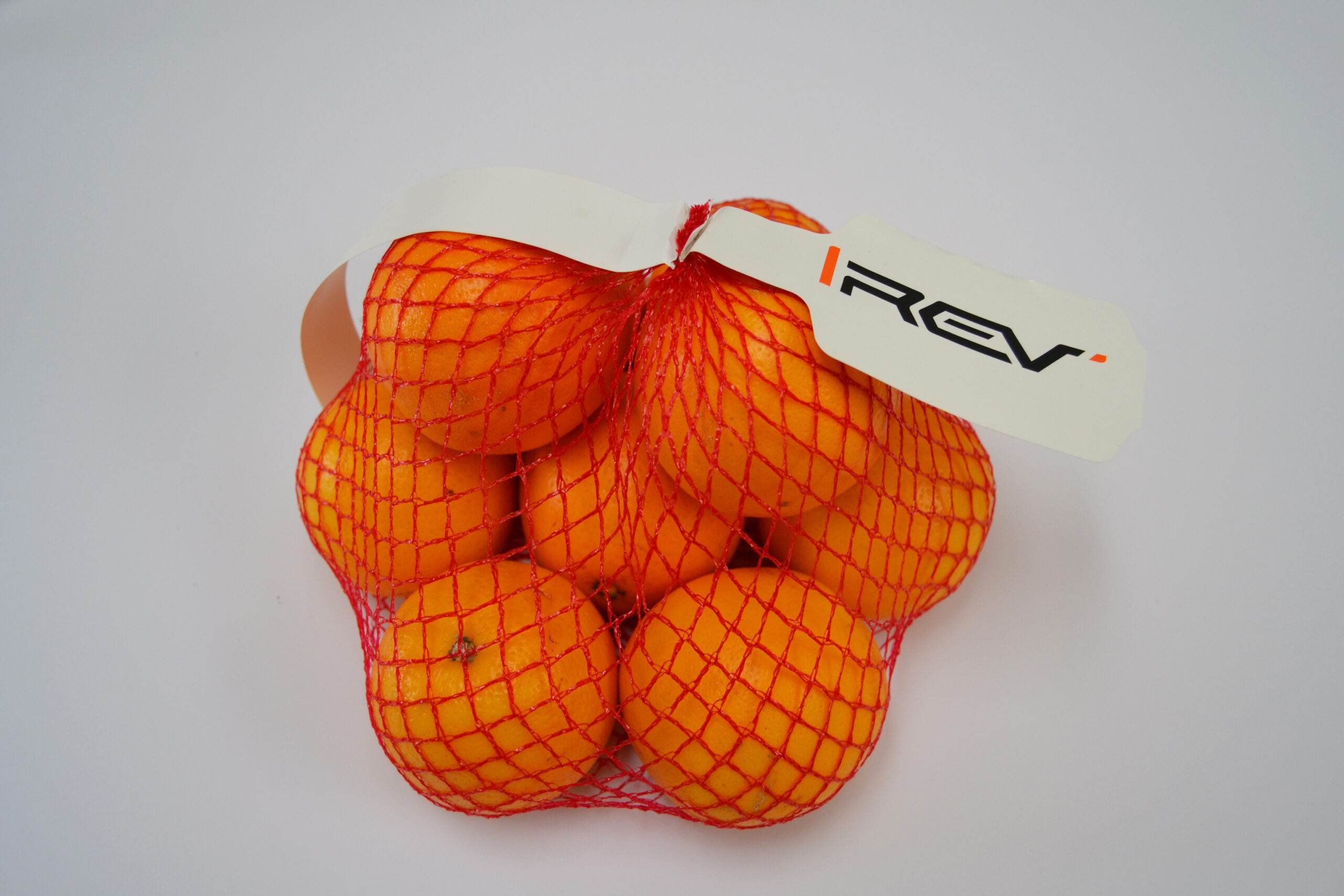
- a PE label, available in weld-to-weld or wineglass versions, customisable in shape and size.
A solution born from real needs
P-Pack was developed following a design approach focused on functionality and material optimisation. Its structure was designed to reduce the overall weight of the packaging while maintaining ease of use, product visibility and adequate space for information. All this without altering the shape of traditional clip nets: in fact, P-Pack retains all their advantages, while being completely monomaterial and recyclable.
What sets it apart from other thermosealed nets
Compared with similar solutions currently available on the market, P-PackⒹ offers tangible advantages:
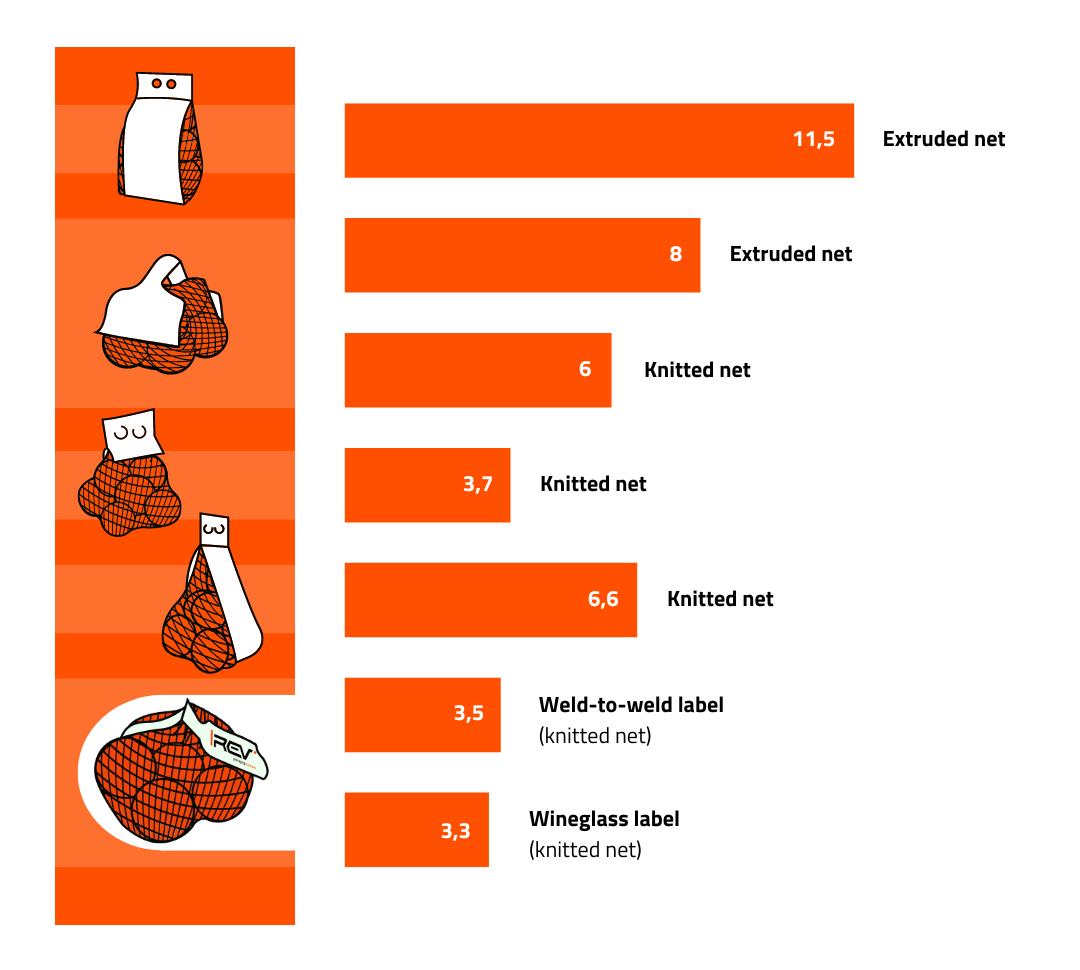
- at least 50% less plastic, making P-Pack the leading solution in terms of sustainability among thermosealed nets for fresh produce;
- an ultra-thin yet spacious label, making the packaging even lighter without compromising functionality or aesthetics;
- a handle that makes the package particularly convenient to carry and handle.
Looking ahead
Design protection meets the need to safeguard a solution that has stood out over time for its technical features and design approach. With P-PackⒹ, there is no need to compromise between practicality and sustainability: the future of net packaging is already written.
To see P-Pack live, come and visit us at FRUIT LOGISTICA, Hall 2.1, Stand B-23. We look forward to seeing you!
FRUIT LOGISTICA 2026
New location for REV and more news ahead
Once again this year, REV confirms its participation in the leading international event for the fresh produce sector and for fresh produce packaging solutions. Of course, we are talking about the highly anticipated FRUIT LOGISTICA, taking place in Berlin from 4th to 6th February.
For the 2026 edition, REV will be moving to a new location. Where can you find us? Hall 2.1, Stand B-23, just a few metres away from our previous position.
That said, you can expect the usual things, along with a few unexpected surprises: the same innovation, the same cutting-edge technology and… unprecedented production continuity!
What to expect
During the event, visitors will be able to discover all the details of P-PackⒹ, the world’s number one thermosealed net in terms of economy and ecology, and much more besides. Visit us at Hall 2.1, Stand B-23 to see live our brand-new solution, designed to ensure highly efficient, uninterrupted workflows… and let production take off!
A very quick recap
📌 FRUIT LOGISTICA 2026, Berlin
📅 4–6 February
👉🏻 Hall 2.1 – Stand B-23
KEEP PRODUCTION RUNNING!
SIVAL 2026
Vega will be the main focus
Everything is ready: from 13th to 15th January we will be attending SIVAL 2026, the leading international trade fair for solutions dedicated to the fruit and vegetable sector, once again held in Angers.
Together with Filpack, we will be presenting live a true classic: the clip netting machine that, more than ten years after its launch, is still able to meet every market requirement and perfectly represent our design philosophy: maximum versatility without compromising on performances.
We are, of course, talking about Vega.
Why Vega
Over the years, Vega has successfully adapted to different markets, products and packaging materials, while keeping its core strengths unchanged: not only operational flexibility, but above all gentle product handling, efficiency and high processing speed.
Designed for packaging loose products up to 2 kg, Vega can also handle particularly delicate produce, working with a wide range of materials, from plastic nets to cellulose and natural fibre nets. To complete the package, it can apply label (including in paper) and handle, also customised.
Format changes are extremely simple as well: since no mechanical adjustments are required, downtime is kept to a minimum and production efficiency takes off!
Where to find us
Come to SIVAL 2026 to see Vega in action and discover all the details. We look forward to welcoming you together with Filpack at Hall B, Stand D-75.
From circular layout to linear layout: a new packaging bench for 6+6
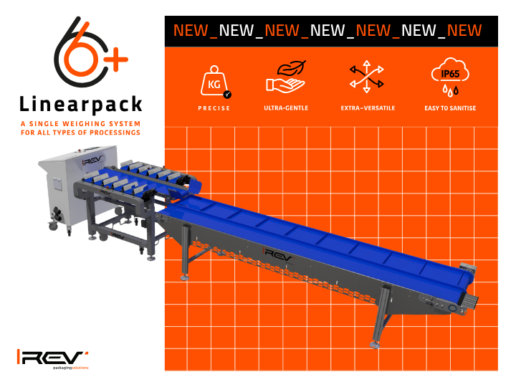
Linearpack has born, a new linear packaging station
The core concept behind 6+6 remains unchanged: a system designed to minimise waste and optimise the composition of each dose. With Linearpack, this principle is reinterpreted in a linear layout.
Order, quality control, rhythm: same philosophy, different flow
Linearpack organizes work in a structured, precise, and repeatable way, ensuring maximum product quality control. However, the linear arrangement, combined with intermittent movement, reduces operators’ movements and makes the workflow even smoother than with Rotopack.
Ergonomics become central: more operational space, fewer manipulations, and a smoother work sequence allow operators to work more comfortably and efficiently. The result is a line designed to support even higher productivity levels.
Advantages of the linear layout
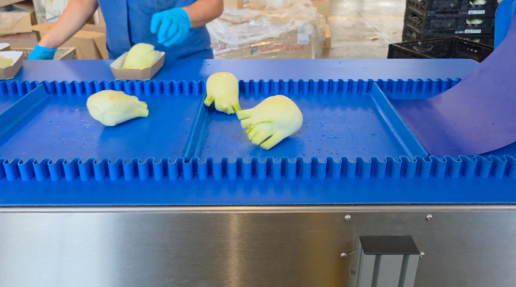
The clear separation between weighing and packaging phases allows each operator to focus on a specific task, reducing errors and idle time.
Thanks to its design, Linearpack can also be integrated with an automatic punnet denester, a key element for managing higher production flows.
In short, if Rotopack set the pace in limited spaces, Linearpack pushes it forward along a line designed for speed, ergonomics, and productivity: two interpretations of the same concept, offering targeted solutions for different production contexts.

Summer break ahead
Closed from August 11th to 15th, but technical support guaranteed
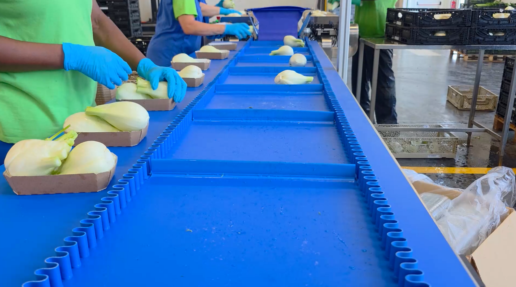
This year, REV is also taking a few days of sun and relaxation, but don’t worry: it won’t even be time to say “summer” before we’re back with you.
From August 11th to 15th, our offices and production will be closed for a very short break, but we know well that emergencies never take a holiday: even during the closure, you can count on our assistance service!
Our technicians will be available from August 11th to 14th, every morning from 8:00 a.m. to 12:00 p.m. You can contact them here:
📞 +39 340 475 1944 / +39 340 291 7268
We’ll see you soon and, in the meantime, happy holidays to those taking a break
Packaging and Packaging Waste Regulation (PPWR)
What will change from 2026 for packaging and its disposal
In February 2025, the PPWR, Regulation (EU) 2025/40 on packaging and packaging waste, entered into force.
The regulation updates and complements the previous texts with some new provisions.
A step back: environmental labelling from the beginning
Environmental labelling, meaning the obligation to indicate the composition and methods of reuse and recycling on all packaging, has been discussed for decades.
This very sensitive issue has been addressed repeatedly:
- Since 2006, it has been mandatory to identify the material each package is made of, to provide clear instructions for recycling.
- In 2020, these indications were required to become clearer and more transparent for consumers as well, theoretically introducing a note on how to dispose of the packaging or an invitation to check with local regulations.
- In practice, however, disposal instructions were postponed multiple times and only became fully mandatory in 2023.
- So, what happens in 2025?
The new developments introduced by the PPWR
The 2025 PPWR establishes that labels must be standardised across the EU – a major step forward for consumers, who currently face unclear and inconsistent information.
To overcome the space limitations of physical labels, a digital format will also be adopted, which is QR codes to provide all relevant details.
From 12 August 2026, once the European Commission has defined (and hopefully explained) the standards of these harmonised labels, all packaging producers must comply with initial goals:
- demonstrate the exact composition of their packaging;
- reduce excessive weight and volume (no more than 50% empty space inside the packaging);
- eliminate hazardous substances from packaging and recycled materials;
- begin applying the principle of design for recycling, which requires that by 2030, all packaging on the market must be at least 70% recyclable.
Penalties will already be applied from 2026 for non-compliance with the initial objectives. In 2028, Harmonised and Digital Labelling will officially come into force, although a transition period will allow companies to sell off existing stocks.
But that’s not all: from 2029, in countries where recycling targets are not met, deposit return systems will be introduced to encourage the recycling of plastic and metal beverage containers.
And again, regarding plastic...
There is still talk of banning single-use plastics, even for unprocessed fruit and vegetables under 1.5 kg.
While this ban makes perfect sense for some products, it’s not appropriate for fresh produce.
Products that will definitely be banned include: ultralight plastic bags (unless used as primary packaging), baggage wrapping at airports, packaging for food and drinks consumed on site in hotels, restaurants and bars, disposable plates, cups and cutlery, and single-use cosmetics in the hospitality sector.
As for fruit and vegetables, no need to panic for now: each Country will define when plastic is strictly necessary for hygiene and safety reasons, and to avoid food waste. This principle will certainly apply to meat, cold cuts and fish – and hopefully also to tons of fruit and vegetables that would otherwise end up in the bin.
Checkweighing gets a blast with Dyno
Utmost precision at full speed
What is Dyno?
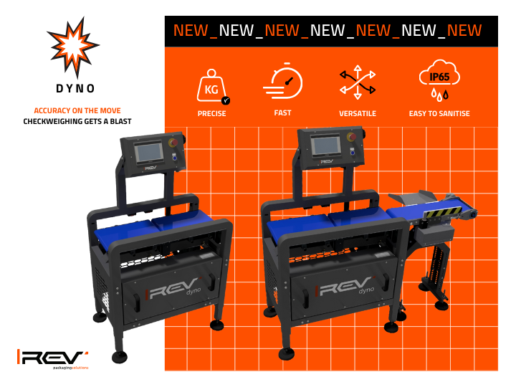
Dyno is a dynamic checkweigher designed to verify the weight of packaged products in motion, without stopping the production line.
The benefits of using a checkweigher
Checkweighing is not just a legal matter: it’s not only about complying with regulations that require declaring a minimum package weight, but above all, it’s beneficial for you!
Why give away your product when you can monitor and verify the exact weight of every single unit? Using a checkweigher is a great advantage for everyone – packagers and consumers.
Why choose Dyno?
Dyno’s technology is based on a weighing system with an optional separate diverter that eliminates vibrations on the scale, ensuring extremely precise measurement at any processing speed.
Moreover, Dyno is ultra-quiet, aesthetically really elegant, ergonomic and easy to use thanks to the touch-screen panel that simplifies the management of operational parameters. But there is more.
Built to last and offer the highest hygiene standards
Dyno is solid and robust, built with state-of-the-art components particularly resistant to wear, and features an IP65 protection rating that makes it very easy to sanitise.
Maintenance is also simple and immediate: the conveyor belts are removable without tools and every part is safely accessible.
What does this mean? Dyno is simply ideal for industrial environments where hygiene and durability are a must!